
Drafting Cube With a Vision
Is There a Right Way to Draft Cube? Should You Just Take the Good Cards?

Welcome to Cuber, Report!, a blog where I go over cube draft reports, cube ideation, and various other topics as they pertain to the format. My name’s Justin, and I hail from Columbus, Ohio. We draft cube weekly at The Warp Gate on Wednesdays at 6:30 pm, so if you’re in the area we’d love to have you join for some cubing! Also, we’re hosting our first grassroots cube event on July 25, 2026. Here’s a link for more information on the event: https://www.tixtree.com/e/columbus-community-cubefest-2026-4b3b4ba180e1. We also have a Bluesky page now for the event; here it is to give it a follow: https://bsky.app/profile/cbuscubefest.bsky.social. Hope to see you there! With all that said, let’s jump into this post’s topic, a discussion on the following: how should you draft cube?
As one goes along their drafting journey, whether that be in booster draft/retail limited or cube, it is inevitable that one will want to get better at drafting. From my own experience, there are a few key tenents that seem to be common amongst the advice given for improving as a drafter. One of the key pieces of knowledge imparted is to, when starting out a draft, take the strongest card out of each pack. As Sam Pratt points out on his podcast Rough Drafts’ episode 31 titled Cube 201, one should “take the good cards.” After all, why would you want to do anything different? Inherent in this strategy is the skill of card evaluation, comparing cards against each other and assessing their potential impact on one’s chances of winning the game. Related to the idea of taking the best card out of each pack is the technique of staying open. By not being overly commital and reading the signals being sent to you from the rest of the table, a drafter can get rewarded by determining a path that is not very contested by other drafters. By balancing the two techniques of taking the powerful cards and staying open, a player can end up with a strong deck by the end of the draft.
Now, is there anything wrong with this approach? No, not at all. However, as I have gone further on my Cube journey and drafted a variety of different cubes, I’ve found myself thinking less and less about taking the good cards and staying open. Have I stopped trying to draft to win with a strong deck? No, but I believe I’ve honed a slightly different drafting strategy that has led to me having more fun while building a deck and playing with it.
I’ve dubbed my personal draft strategy “Drafting with a Vision.” To start, let’s look at a sample pack from my new peasant cube Maximum Artifice (an artifact-centered peasant cube, hence the name) to see what I mean. Here is a link to the primer if you want a little bit of background on what’s going on in the cube: https://cubecobra.com/cube/about/c563a489-6aa6-453b-b260-db3cfad7c70e?view=primer
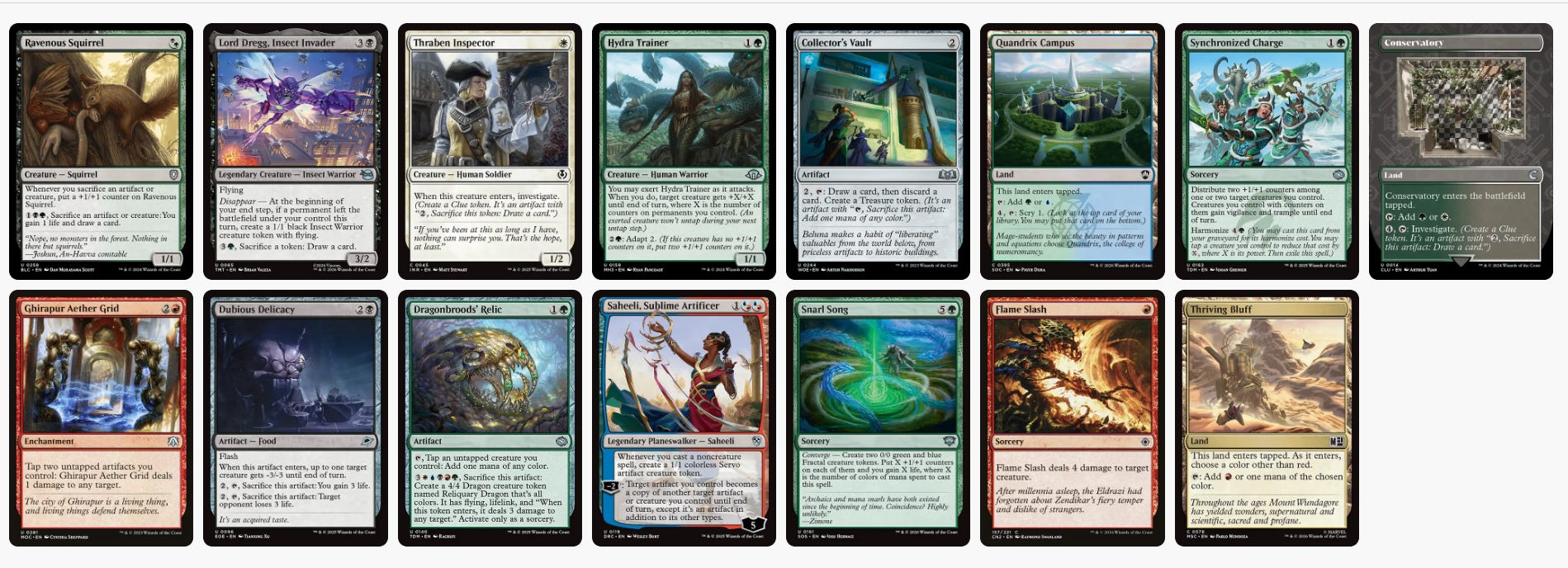
(yes, there is a +1/+1 counters strategy. You gotta do something with Selesnya in an artifact cube.)
If one is drafting with the ideas of taking the strongest card out of each pack and staying open, I think there are three picks one could choose. The first is Thraben Inspector. The card is efficient, makes two pieces of cardboard (one of which is an artifact), and can be bounced for repeated value. The same can be said for Dubious Delicacy. It’s an artifact itself, an instant speeed piece of removal, can be replayed or sacrificed for value, or used as a final piece of reach to finish off the opponent. The last card I would consider in this framework is Flame Slash. Any red deck would play it, as one mana deal four is about as efficient as you can get for a removal spell. I think that all three cards could be taken if one is starting out a draft trying to take the strongest card out of each pack while also staying open to the signals from the rest of the table. But how do you distinguish between them, and are there any other paths that one could reasonably consider?
I believe that Drafting with a Vision can provide some help. So what is it exactly? I would say the philosophy is that one can have a potentially more rich, interesting cubing experience if one asks oneself how you can maximize the potential of each card you take out of a pack by how you choose what future cards you take. In other words, a drafter can take a card not solely because it is strong from a power-level perspective, but because when its connections with other cards and the rest of the cube are maximized, it can help build a deck that is more than the some of its parts. Cube picks are made in succession; a drafter can therefore think about how each card picked helps build the bigger picture one is aiming for through the connections the pick as have with previous choices. An astute reader may be thinking that all of these points make it sound like I’m talking about synergy, and I think they would be correct. As I’ve developed as a cuber, I’ve found that my picks are less determined by what the strongest option is, and moreso by how I can combine my choices into a connected, synergistic whole.
Let’s go back to the pack above and consider our options. With regards to the Inspector and Delicacy, if I take those cards, I am immediately thinking about how I can maximize their potential. A Lightning Bolt may appear in the next pack; that card is in the cube, and by all measures it is one of the best cards in the cube. Indeed, it’s one of the best red cards ever made. But what if there is a card that combines especially well with the Inspector or the Delicacy from a connective, synergistic perspective? For example, an Essence Reliquary could also be present in pack 2. There is a very strong argument that Lightning Bolt is a better card than Reliquary. If one is drafting the best and most flexible card out each pack early on, it is easy to see why one would take the Bolt over Reliquary. That said, I could easily imagine myself taking the Reliquary. Doing so forms a more connective tissue, so to speak, between my first and second picks, and provides a vision, an end goal, to pursue going forward in the draft.
Drafting with a Vision can lead to some early picks that are even more radical. For example, in the pack above, what if one is feeling spicy and wants to draft a multicolor/five color pay off deck? If one thinks carefully, there’s a vision to pursue in this pack. You could take the Collector’s Vault, Dragonbroods’ Relic, or Snarl Song, with the idea being to wheel one of the two that you don’t take. Another path could be to take Ghirapur Aether Grid and look to maxixmize on token-making for tap fodder. I would agree that that all of these picks are less “strong” and not as flexible as taking Thraben Inspector, Dubious Delicacy, or Flame Slash. However, for some drafters at least, they may be more fun! Taking a more synergy-driven pick can open up the challenge of navigating through the draft towards a deck that maximizes that synergy.
This strategy of drafting has been very rewarding for me. Rather than adhering to card evaluation focusing on raw strength or passively letting the signals at the table determine what direction I should pursue, I’ve found that Drafting with a Vision has allowed me to be a more active participant in the draft. Rather than letting my deck’s final picture develop slowly, I frontload that development, thinking very carefully how each pick connects with the previous ones.
Now, I do think that this approach is better suited for some cubes over others. In particular, the more synergistic and lower power an environment is, the more reasonable it is to practice Drafting with a Vision. For example, a classic Vintage Cube may not be the best fit for this strategy. Some cards in such a cube are so strong that it might be embarassing to pick something else over them. You can’t really pass an early Black Lotus or Time Walk, can you? There are decks that said cards fit better in over others, and a drafter can make picks with these decks in mind, but what happens when a Pyrogoyf or Minsc & Boo, Timeless Heroes pops up relatively early? These cards are so strong that it relatively difficult to pass them if one is trying to win.
On the opposite side of Vintage Cube, some cubes are built with synergistic, thematic archetypes at the forefront of design. Indeed, one could argue that all of the cubes I drafted at this year’s Boston Cube Party all fit into a synergy-forward framework. I believe that drafting these cubes played some part in my success at the event. You can read my event report here. My preference for Drafting with a Vision, an approach geared towards constructing a deck built upon the connnective tissue between cards, fit well into these environments.
Of course, I do not believe that a drafter should always “force” or “soft-force” an archetype from the jump. Even I, one who loves synergy, will know when to abandon ship if the vision I am trying to pursue is clearly not going to have a chance of working out given what I’m being passed. Also, my penchant for synergy has limits. Some cards, despite having a point for being in the cube, don’t really make sense to pick early on. Perhaps they don’t meet the threshold for power-level, which I am still looking for, or they don’t provide much of the foundation for a vision to pursue. For example, I wouldn’t find myself drafting Synchronized Charge out of the pack above. It is a pretty good card, but it is just narrow enough to avoid early on. My ideal picks are both synergistic and flexible.
And that’s about all I have to say about Drafting with a Vision. I’ve found this approach to be very rewarding and fun. Relatedly, I’ve found that I like cubes in which this strategy works well to be some of my favorites. Should you probably take the strongest, most flexible card early on if you are trying to win? Probably, but as demonstrated, I believe thinking about how you can maximize the inherent synergies of your early picks, or looking for more creative, ambitious early picks, can lead to a unique drafting experience.
Thanks for reading, and happy cubing!